Home
Ab initio determination of light hadron masses
Science 322 (2008) 1224
Supporting online material
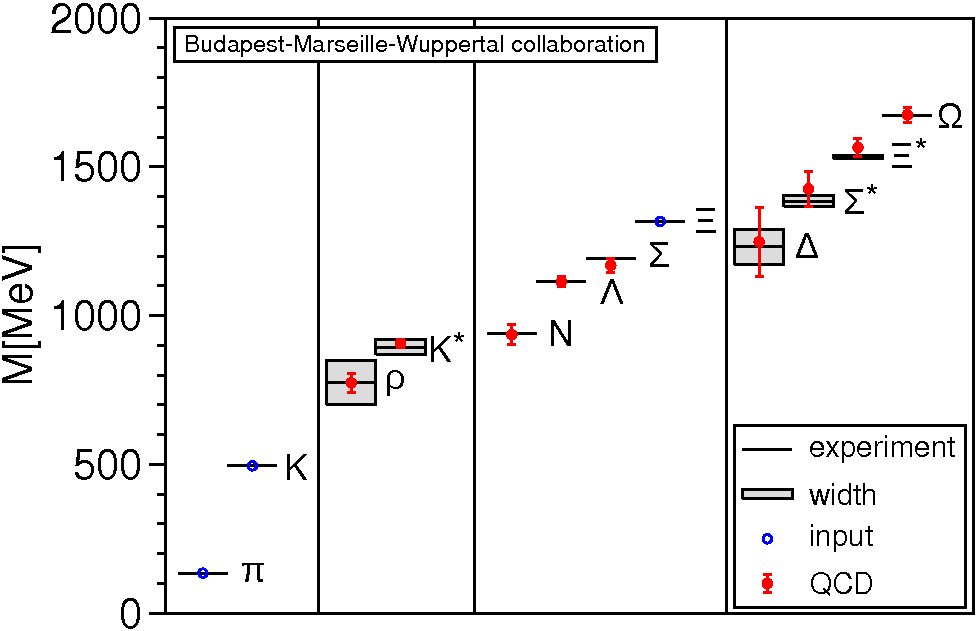
The light hadron spectrum of QCD. Horizontal lines and bands are the experimental values with their decay widths. Our results are shown by solid circles. Vertical error bars represent our combined statistical (SEM) and systematic error estimates. The pion, kaon and cascade have no error bars, because they are used to set the light quark mass, the strange quark mass and the overall scale, respectively.
More information
-
In the media (English and French)
- Mass by numbers (Frank Wilczek, Nature 456 (2008) 449)
- The Weight of the World Is Quantum Chromodynamics (Andreas Kronfeld, Science 322 (2008) 1198)
- Breakthrough of the year: the runners-up (Science Magazine news team, Science 322 (2008) 1768-1773)
- At Long Last, Physicists Calculate the Proton's Mass (Adrian Cho, ScienceNOW 1121 (2008) 2)
- Masse du proton : le calcul est bon (François Savatier, Pour la Science 375, janvier 2009)
- Le secret de la masse du proton est percé... (Laurent Sacco, Futura-Sciences, 22 novembre 2008)
- Quid novi: les physiciens à la masse (Le Point, 27 novembre 2008).
- Calculating the mass of a proton (Mark Reynolds, CNRS International Magazine 13 (2009) 11)
- Nuclear masses calculated from scratch (Philip Ball, Nature News (2008) 1246)
-
More Nobel comments
- QCD: 36.5 years later (David Gross, talk at "QCD: The Modern View of the Strong Interactions", 4-6 October 2009, Berlin)
- Theoretical visions (David Gross, talk at "Physics at the LHC 2010", 7-12 June 2010, Hamburg)